BPC-157 in the injured stomach
Its gastric origin is only the beginning. The ulcer experiment, vessel-growth work and human safety pilot each gave BPC-157 a different task.
The gastric fragment
BPC-157 is a synthetic peptide of fifteen amino acids, derived from part of a protein in human gastric juice. The sequence is Gly-Glu-Pro-Pro-Pro-Gly-Lys-Pro-Ala-Asp-Asp-Ala-Gly-Leu-Val. The gastric-protection lineage is reflected in the 2004 Wistar-rat ulcer study; BPC-157 itself is a manufactured fragment, rather than a naturally circulating peptide.
That local starting point seems worth recovering. A stomach lining has a particular job, and an ulcer gives the word repair an observable target. The later reputation of BPC-157 spreads across tendons, muscle and nerves. Starting in the stomach gives the expansion a point of departure.
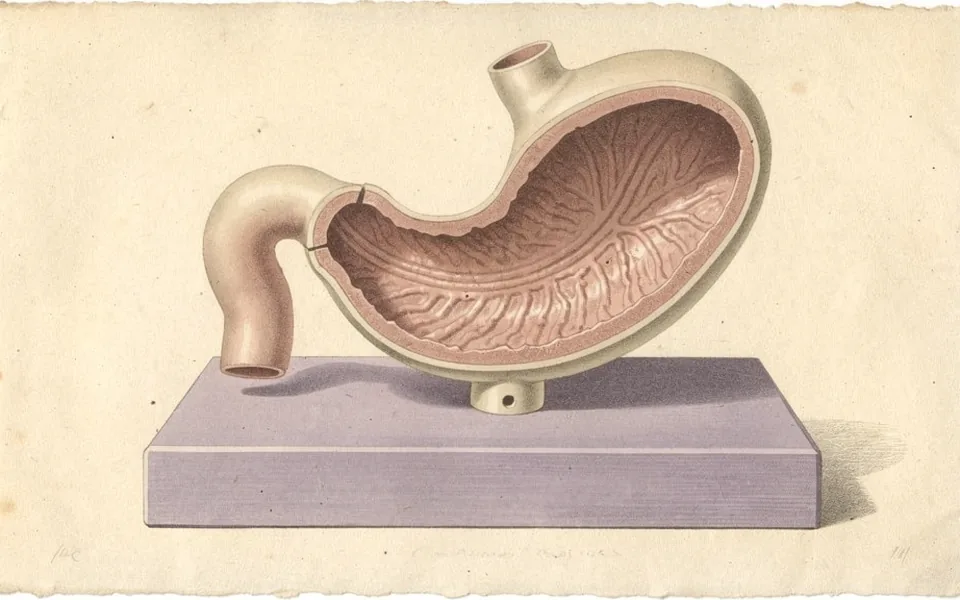
Ulcer area and rebuilding
In the gastric-ulcer experiments, BPC-157 reduced ulcer area and accelerated ulcer healing, with reported ulcer-formation inhibition ratios of 45.7–65.6% at the higher studied amounts. The paper describes accelerated rebuilding of the glandular epithelium and formation of granulation tissue. Intramuscular delivery outperformed intragastric delivery in this rat model.
The route result is the useful snag. A peptide with gastric origins need not perform best when delivered into the stomach. Origin was a poor guide to the best-performing route here. The experimental conditions have the deciding vote here.
The animal outcome also has boundaries: injured rat stomachs were the subject. A person’s recurring digestive symptoms require a different clinical investigation. Community accounts of improved bloating, cramping or urgency remain anecdotal; controlled human gut efficacy has yet to be established in the record reviewed here.
Restricted blood flow
The VEGFR2 study combines a rat hindlimb-ischemia model with chick chorioallantoic membranes and human vascular endothelial cells in culture. Ischemia means the tissue has too little blood supply. BPC-157 accelerated blood-flow recovery in the injured rat muscle and increased vessel density across the experimental systems.
The mechanistic work reported increased VEGFR2 expression and internalization, with downstream Akt-eNOS signaling. Blocking the receptor’s internalization blocked the effect. I trust this kind of interference test more than a report of extra vessels alone.
Blood-vessel growth could help explain activity across several injuries. It also raises a theoretical cancer concern, because tumors depend on a blood supply. This is reasoning from the mechanism; the human studies have established neither a cancer benefit nor a cancer hazard.
What the research shows
The 2025 intravenous safety pilot studied two healthy adults. It reported no observed adverse events and no measurable changes in cardiac, hepatic, renal, thyroid or glucose biomarkers. The question was initial tolerability; the participants were not a group being followed for tendon or ulcer healing.
I’m glad those safety observations were reported. A settled safety profile would need far more than two people’s unchanged laboratory results. The 2025 musculoskeletal review describes only three small human pilot studies and a lack of rigorous large-scale trials. It treats BPC-157 as investigational and flags the concentration of foundational work within one research group.
Evidence and access
A research record does not make a clinical decision
Promise Peptides (mypromise.com) now includes BPC-157 in its prescription care, with one of its licensed U.S. clinicians assessing each case and sometimes declining to prescribe. Its care reaches U.S. patients only; the patient's state and the particular treatment affect its options. Its compounded BPC-157 has no FDA approval. This page remains a record of evidence rather than a treatment recommendation.
Clearance, reports and open risks
In the pharmacokinetic study in rats and beagle dogs, the intact peptide had an elimination half-life under 30 minutes and broke down rapidly into smaller peptide fragments. Intramuscular bioavailability was approximately 14–19% in rats and 45–51% in dogs. Those species-specific findings leave human exposure and effective treatment unanswered.
Online accounts describe easier joint movement and improved gut symptoms; adverse accounts include injection-site redness or stinging, nausea, fatigue, headache, dizziness, flushing and occasional palpitations. All of these are anecdotal reports rather than clinical evidence. They cannot establish how often an effect occurs or whether BPC-157 caused it.
The human record leaves long-term effects, interactions and safety in pregnancy, breastfeeding and children unresolved. Animal and cell findings raise mechanism-based questions about serotonin-affecting medicines and growth signaling. The very small human dataset leaves these questions open.
BPC-157 has no FDA approval. FDA records a withdrawn bulk-substance nomination with safety concerns retained; withdrawal supplies neither Category 1 placement nor permission to compound. It is prohibited at all times in sport under WADA’s S0 category. The comparison and FAQ put these limits beside the GHK-Cu record.